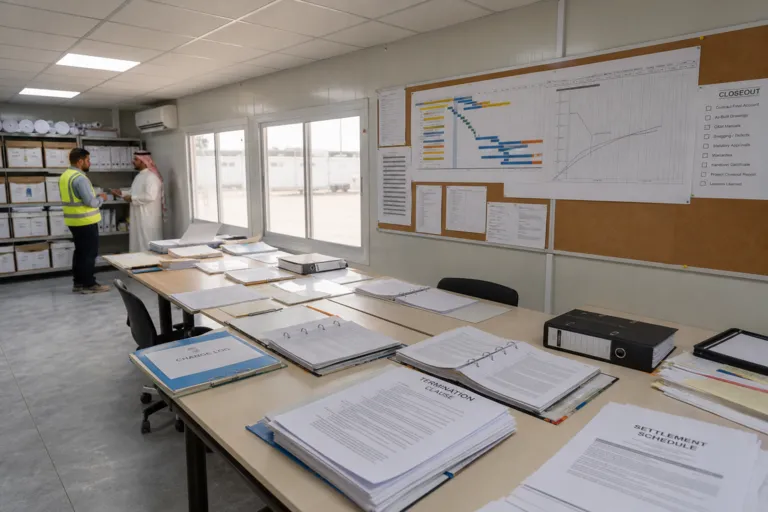
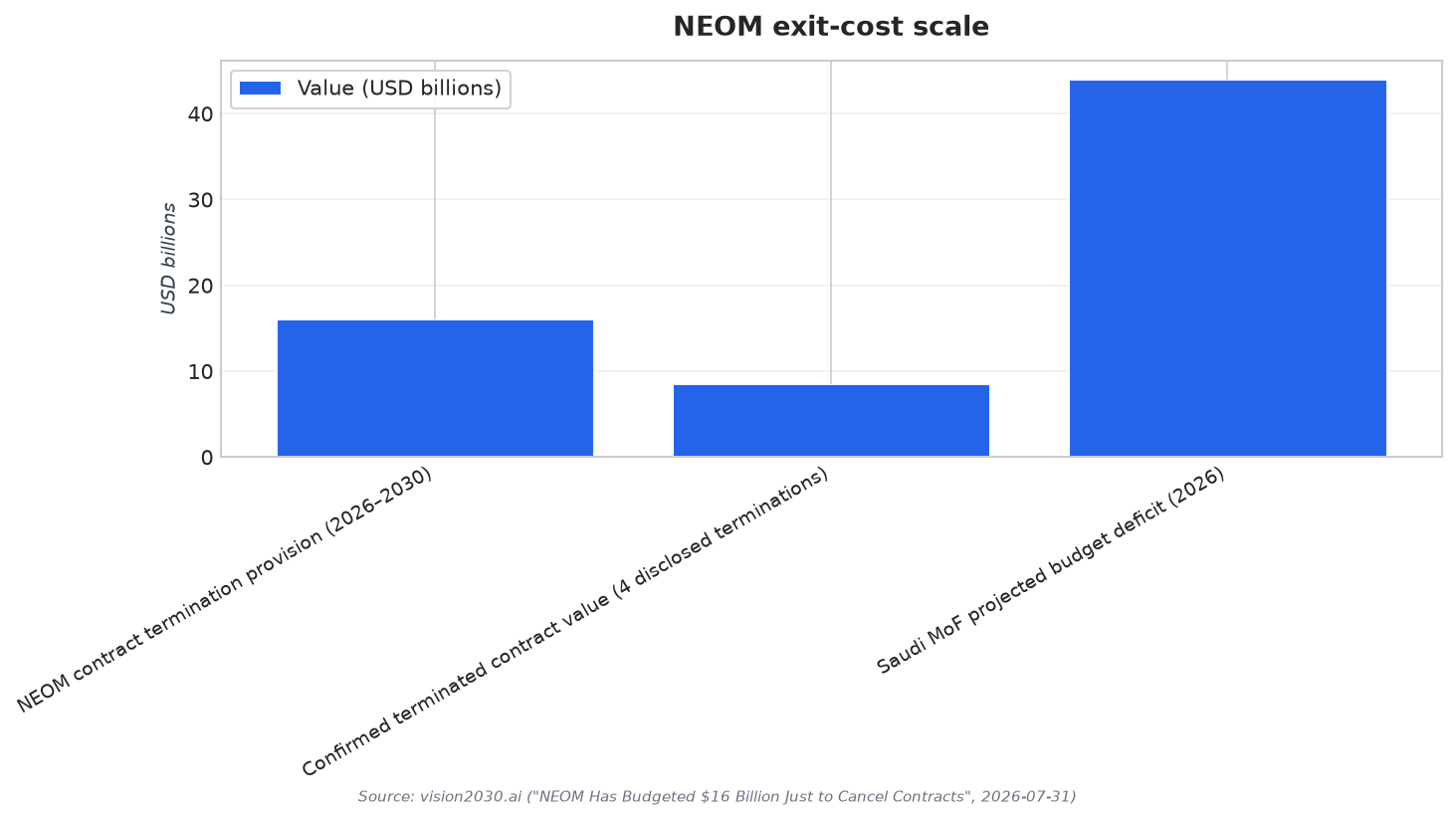
In 2026, NEOM’s restructurings and cancellations turned “exit rights” from boilerplate into board-level risk. Reporting cited by Vision2030.ai says NEOM set aside SAR60bn ($16bn) between 2026 and 2030 for anticipated payments to terminate long-term agreements, tied to penalty clauses and subject to negotiation. The same source notes NEOM’s new development spending over that period at about SAR40bn ($10.7bn), concentrated on Oxagon and utilities, implying that planned cash for exits can rival planned cash for building. Vision2030.ai also frames the SAR60bn provision against the Saudi Ministry of Finance’s projected SAR165bn ($44bn) budget deficit for 2026, described as 3.3% of GDP.
“Termination for convenience” is the clause family at the center of this story. Vision2030.ai describes it as an employer right to end a construction contract at any time, for any reason, without alleging contractor failure. In that framing, the contractor demobilises and is reimbursed for what it has spent, while the employer absorbs sunk cost and keeps what has been built. ContractKen similarly explains that termination for convenience allows exit without cause, typically with advance notice, and that key variables include notice period, who can invoke it, and payment obligations for work performed through the termination date. In other words, the clause shifts disputes away from blame and toward measurement: what was done, what was ordered, and what it costs to wind down.
Lost Profit vs. “Made Whole”: What Recovery Can Really Mean
Contractor expectations can diverge sharply from what termination for convenience actually pays. House of Saud describes the Gulf construction pattern under FIDIC-based templates as giving the employer an unconditional right to halt work, while the contractor is made whole for work in progress, materials ordered, equipment mobilized, subcontractor commitments, and full demobilization. That same source stresses that the deeper a project advances before cancellation, the closer exit cost can converge with completion cost. ZAWYA reported in March 2026 that cancelled or affected NEOM works could potentially exceed $5bn based on contractor disclosures, and added that contractors said terminations were exercised under contractual rights and would not result in financial losses after settlement of completed works. That is a different claim than “lost profit,” and it highlights why settlement scope and definitions matter.
The numbers that are already public show how quickly “convenience” becomes expensive. Vision2030.ai says four terminations documented in contractor regulatory disclosures total about $8.45bn of terminated contract value, and House of Saud repeats that $8.45bn in confirmed cancellations covers roughly half of the $16bn budgeted termination cost. House of Saud also says Webuild’s two cancelled NEOM contracts alone had a combined face value of $6.3bn. Alongside contract exits, Invest Riyadh’s brief describes a major rescaling: it says the first phase of The Line was reduced from 170 kilometers to approximately 2.4 kilometers, and the 2030 population target was cut from 1.5 million to 300,000, while referencing an estimated $8bn in write-downs and contract restructurings across the supply chain.
For recovery after cancellations, the practical playbook is paperwork and timing. ContractKen notes that termination for convenience commonly turns on items like payment for work performed through the termination date, treatment of work in progress, and wind-down requirements. House of Saud adds that reimbursable buckets can include materials ordered, equipment mobilized, and subcontractor commitments, plus demobilization. That creates a contractor priority list: prove costs, show commitments, document progress, and track off-site procurement so it is not stranded in dispute. In the Saudi context, the key phrase “termination for convenience Saudi giga project contracts” is less about a slogan and more about a settlement mechanism that can protect cashflow if the contractor can evidence what it is owed and close out fast.
What is termination for convenience in major Saudi construction contracts?
How large is NEOM’s reported budget for cancelling contracts?
Do NEOM terminations automatically mean contractors suffer financial losses?
What has been publicly confirmed about cancelled contract values at NEOM?
What should firms focus on when navigating termination for convenience Saudi giga project contracts?
Talk to us for your needs in:
-
Sustainable Construction Solutions
-
Strategic Construction Planning
-
Customer-Centric Construction Services
-
Operational Excellence in Construction
-
Leadership and Change Management for Construction
-
Digital Transformation in Construction
-
Saudi Construction Market Research
-
In-Depth Market Study for Construction
-
Market Intelligence and Insights in Construction
-
Feasibility Study and Assessment in Construction
-
Saudi Construction Benchmarking