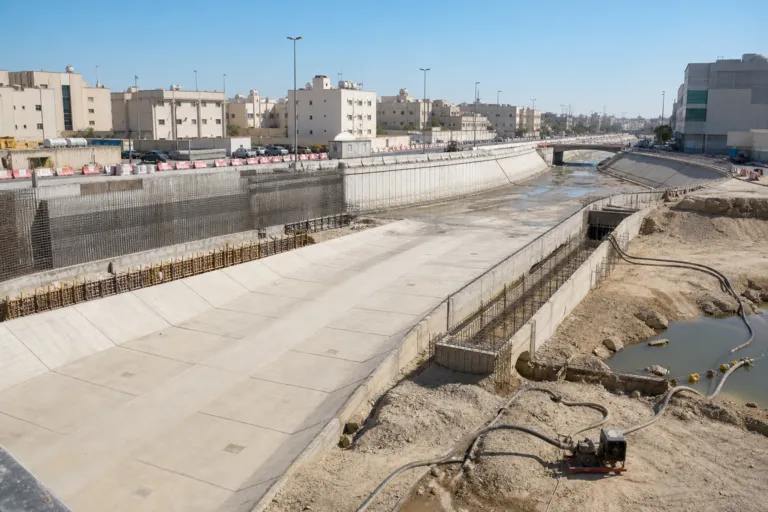
After Saudi Arabia’s 2026 flash-flood events, urban stormwater and drainage construction moved from a background utility topic to a central resilience priority. Research on the Arabian Peninsula shows a notable increase in flash-flood and rainfall publications since approximately 2010, with most studies concentrating on Saudi Arabia. That growing body of work is not just academic. It points to actionable needs in drainage planning, from how storms are analyzed to how mitigation measures are evaluated over their full service life in fast-changing urban areas.
One recurring finding in the regional literature is risk pressure from rainfall patterns. A bibliometric review of flash-flood and rainfall studies in the Arabian Peninsula reports that most studies show increased rainfall intensity, which raises the risk of flash floods. For construction teams, this is a design signal: stormwater conveyance and storage must be planned as systems that perform under short, intense events, not just average conditions. The same review flags a specific research gap: rainfall analysis based on minimum interevent time to improve the performance of hydrological analysis, which can influence sizing, phasing, and redundancy in urban drainage networks.
What “Build Back Better” Can Mean for Stormwater Construction
“Build back better” in Saudi cities can start with decisions that connect engineering to long-term operations and costs. The Arabian Peninsula review underscores the importance of economic and life-cycle assessments of mitigation measures, implying that construction choices should be tested not only for peak-flow control but also for durability, maintenance, and performance over time. It also calls for dam safety re-evaluation based on updated hydrological data and urban development trends. That matters for downstream urban drainage planning, because protective infrastructure and expanding impervious areas can shift runoff timing and routing, changing what city systems must handle.
Jeddah is often discussed in Saudi flood literature as a place where drainage pathways and urban form interact. A study on catastrophic impacts on modern Jeddah describes disastrous flash floods occurring frequently during the last few decades and links them to short-spelled torrential heavy rains. It notes high water levels in urban centers along the Red Sea coastal plains and in high-gradient terrains of large braided wadi networks. The same work highlights the use of remote sensing, GIS modeling, and geological map analysis to understand flood dynamics and urban impacts on drainage patterns, tools that can guide where channels, detention features, and protected corridors should go.
Global market signals also show what many cities are prioritizing, which can inform procurement and delivery models without being treated as Saudi-specific data. A climate-resilient city market report states that, between 2023 and 2025, deployment of nature-based stormwater management increased by approximately 30% globally, and that demand for stormwater storage basins, retention ponds, and modern drainage systems increased by 28% as cities attempt to cope with cloudbursts and heavier rainfall. The same report says that as of 2025, more than 1,500 cities worldwide have adopted formal climate-resilience plans, and over 40% of major climate-resilience projects are delivered through public-private collaboration or private investment. For urban stormwater flood drainage construction in Saudi Arabia, these patterns suggest a practical mix: engineered capacity plus green-blue features, delivered through partnerships that can sustain operation and upkeep.
What research gaps matter most for Saudi Arabia’s stormwater drainage construction after the 2026 flash-flood events?
What does research say about rainfall intensity and flash-flood risk in the Arabian Peninsula?
Why is Jeddah often used to discuss urban flooding and drainage pathways in Saudi Arabia?
What global trends can guide urban stormwater and drainage upgrades, without claiming they are Saudi figures?
Talk to us for your needs in:
-
Sustainable Construction Solutions
-
Strategic Construction Planning
-
Customer-Centric Construction Services
-
Operational Excellence in Construction
-
Leadership and Change Management for Construction
-
Digital Transformation in Construction
-
Saudi Construction Market Research
-
In-Depth Market Study for Construction
-
Market Intelligence and Insights in Construction
-
Feasibility Study and Assessment in Construction
-
Saudi Construction Benchmarking