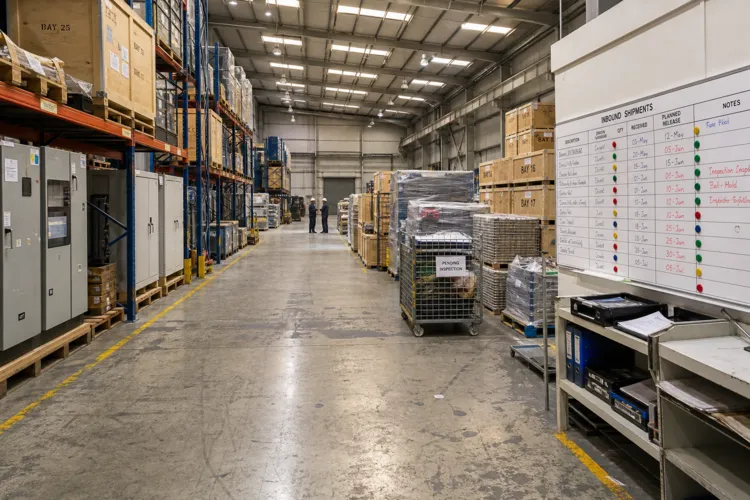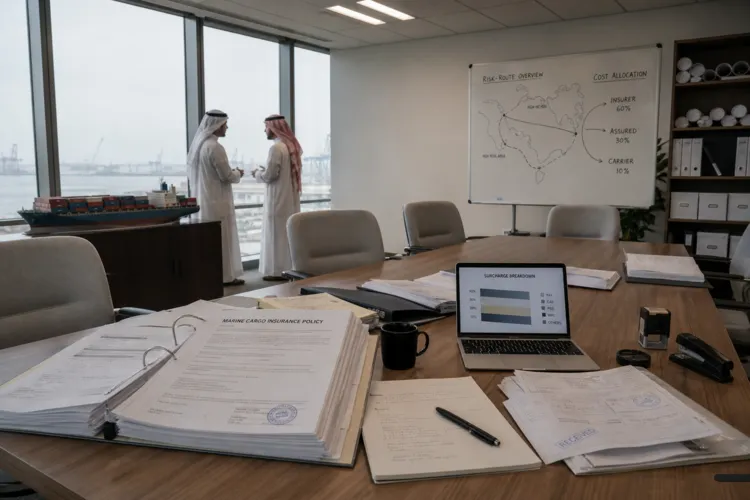
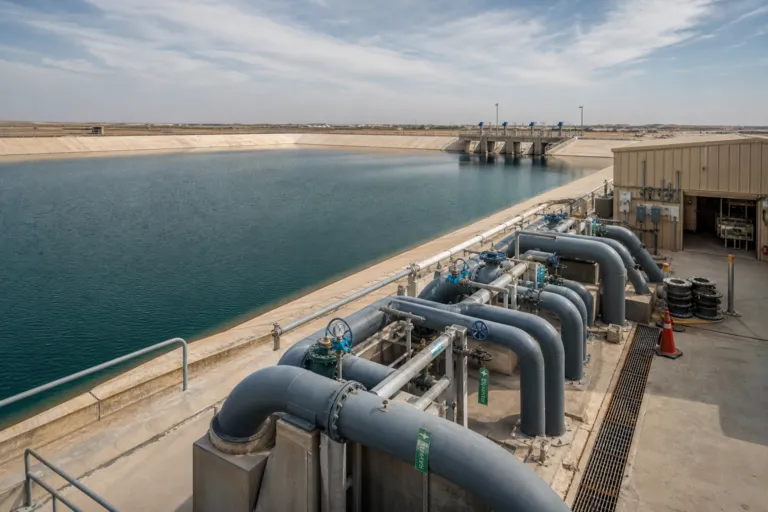
Saudi Arabia’s water-security model is shaped by extreme scarcity, high urban growth, and seasonal demand peaks, alongside the challenge of moving water across a vast geography. The Kingdom receives less than 100 millimetres of average annual rainfall and has no permanent rivers or freshwater lakes, so it relies on desalinated seawater, non-renewable groundwater extraction, and treated wastewater. Desalination is described as the backbone of the urban water model, with total production capacity exceeding 7.5 million cubic metres per day and about 22 per cent of global desalination capacity. But supply security also depends on transmission portfolios and strategic reservoirs that can stabilize delivery when demand surges or operations are disrupted.
Planning evidence points to a material storage shortfall that drives the case for strategic builds. Khatib and Alami’s Strategic Reservoir Studies state that Saudi Arabia is facing a significant strategic storage gap of over 50 million cubic meters. The Water Transmission Company (WTCO) commissioned Phase 1 work that evaluated 300 potential reservoir sites across the Kingdom, aligning with the National Water Strategy and Saudi Vision 2030. The same program required managing data from 566 storage sites serving about 800 city gates through a comprehensive GIS database, with continuous updates for facilities that were existing, under construction, or under design. This is the practical context for strategic water reservoir pipeline construction Saudi Arabia needs for near-term resilience and long-horizon reliability.
From Priority Reservoir Batches to Transmission-Ready Packages
The reservoir master plan is not only a long-term vision to 2075; it is also structured around near-term delivery packages. Two priority batches are scheduled for implementation by 2030 and are expected to provide 11 million m³ of new water storage. The planning work also studied optimal locations for reservoirs, associated supply line routes, and operational use, following technical and planning standards. Achieving stakeholder consensus was treated as a major delivery issue, with structured decision analysis used around a $2.6 billion prioritization methodology. This kind of front-end definition supports faster project development because routes, capacities, and sequencing are addressed early, instead of being discovered late in construction.
Transmission pipelines and “city gates” reservoirs are a visible implementation layer, especially around major demand centers. The U.S. Department of Commerce notes that in Riyadh region, NWC is expanding and improving water supply systems by constructing “city gates” reservoirs to receive potable water from desalination plants, transmission pipelines, and water networks. It also states that between 2022 and 2030, SWPC plans to bridge gaps in water production, strategic storage, and treatment capacities by analyzing supply and demand during this period and deploying projects accordingly. WTTCO is described as the government-owned entity responsible for development, implementation, management, operation, and maintenance of water transmission, storage, and support systems across regions, which places pipelines and reservoirs under one system-level operating logic.
Strategic storage and pipelines also sit alongside reuse and digital planning tools in the 2026 resilience conversation. OFW Intelligence links reliability to strategic reservoirs, Hajj and Umrah peak planning, and wastewater infrastructure, and highlights a 70% treated sewage effluent reuse target by 2030 as part of a circular water economy approach. Khatib and Alami similarly flag seasonal surges during Hajj and Umrah, emphasizing the need for adequate supply for millions of pilgrims. Meanwhile, Saudi Arabia’s hosting of IDWS 2026 in Jeddah from December 7-9, 2026, under the Saudi Water Authority is framed as part of a broader effort to shape water innovation and standards. Together, these signals point to a system strategy: produce, store, move, reuse, and manage demand with better forecasting and coordination.
Why do strategic reservoirs matter if desalination capacity is already high?
What concrete storage additions are planned in the current reservoir master plan?
How is Saudi Arabia organizing transmission-pipeline and city-gate reservoir work in Riyadh region?
How does Saudi Arabia plan to use data to prioritize reservoir and pipeline projects?
What does strategic water reservoir and pipeline construction in Saudi Arabia connect to beyond storage?
Talk to us for your needs in:
-
Sustainable Construction Solutions
-
Strategic Construction Planning
-
Customer-Centric Construction Services
-
Operational Excellence in Construction
-
Leadership and Change Management for Construction
-
Digital Transformation in Construction
-
Saudi Construction Market Research
-
In-Depth Market Study for Construction
-
Market Intelligence and Insights in Construction
-
Feasibility Study and Assessment in Construction
-
Saudi Construction Benchmarking