Embodied carbon reporting is becoming a practical delivery issue, not a niche sustainability exercise. A 2026 report by the Rocky Mountain Institute and Skanska says construction project teams are proving they can reduce embodied carbon emissions from buildings without raising costs. It links this progress to advances in data, stronger standards, and smarter procurement. For Saudi projects, this framing matters because giga-project scale increases scrutiny, and procurement choices can lock in impacts early. The keyword reality for many bid teams is embodied carbon reporting Saudi construction, because the work is moving into tender language, evaluation, and investor expectations.
Methodology is the first tender battleground. The same 2026 report notes that confidence in embodied carbon measurements is improving steadily through higher-quality data, greater industry participation, and more robust measurement tools. It also points to guidance documents that provide verifiable means of measuring and reporting embodied carbon consistently. These include ASHRAE/ICC’s 240P Standard for all buildings, RESNET’s 1550 Standard for residential buildings, and ASCE’s Prestandard for structural systems. On Saudi projects, tender requirements can use this kind of language to reduce disputes: define the standard to follow, require consistent reporting formats, and request verifiable outputs instead of marketing claims.
Tools and Workflows: From BIM Data to Reportable Evidence
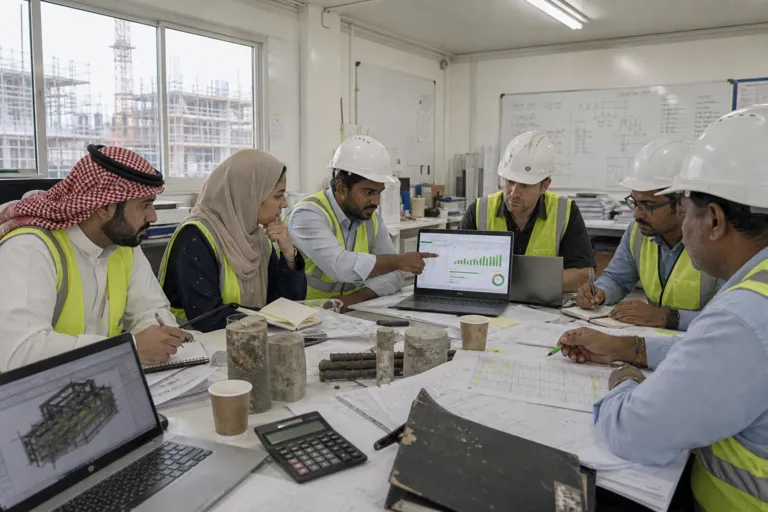
Tools matter because reporting is only as strong as the data trail behind it. In Saudi Arabia, GBS describes enabling project teams through Autodesk Construction Cloud (ACC) and connected BIM workflows across Revit, AutoCAD, and Navisworks. The same release says GBS trained and certified over 60 Saudi engineering professionals in advanced digital project delivery workflows. For embodied carbon reporting, these connected workflows support the basic needs of tenders: traceability, coordination, and repeatable documentation across designers, contractors, and suppliers. The practical lesson for 2026 is that reporting is increasingly a systems problem, not just a calculator problem.
Early-stage embodied carbon assessment is where tenders can create real leverage. A 2026 edie webinar preview explains that many organisations are now better at calculating embodied impacts, but measurement alone does not deliver lower-carbon buildings. It argues the bigger challenge is turning embodied carbon data into earlier, better decisions on design, specification, procurement, and refurbishment. It also stresses acting earlier in the construction process, where meaningful reductions are easiest to enact, including comparing design options, challenging unnecessary material use, and identifying opportunities for retrofit and reuse. For Saudi bids, this supports a tender shift: require early-stage assessments and decision logs, not only a final report at handover.
Tender competitiveness is increasingly tied to trusted proof. In Australia, NABERS’ Embodied Carbon rating is described as providing builders and developers trusted, independently verified proof that a project has genuinely reduced construction-related emissions. The same article says such a rating strengthens credibility with investors and provides a clear competitive advantage in tenders and leasing, particularly as government and corporate clients increasingly seek low carbon buildings. It also describes scope across manufacturing materials, transporting them to site, energy use and waste onsite. For Saudi projects in 2026, the transferable concept is clear: tenders can reward independent verification, defined boundaries, and evidence that covers site impacts as well as product impacts.
Finally, supply-chain reporting expectations are hardening globally, which can influence Saudi procurement and imported materials. A 2026 interview about Europe’s automotive supply chains says regulations such as the EU Battery Regulation, CBAM and digital product passport requirements are making carbon reporting effectively mandatory, and that in Europe this is treated as a baseline condition for doing business. Saudi mega-developments like Diriyah sit inside Vision 2030 ambitions, with the Diriyah scheme described as a $63.2bn transformation and a first phase designed to host 100,000 residents and attract up to 50 million annual visits. In that environment, 2026 tenders can increasingly treat embodied carbon reporting as baseline governance: standardised methods, digital evidence, early-stage action, and verification-ready outputs.
What does “embodied carbon reporting Saudi construction” mean in 2026 tenders?
Which standards are cited as helping consistent embodied carbon reporting?
Why do tenders push early-stage embodied carbon assessments?
How can digital workflows support embodied carbon reporting on Saudi projects?
Why does independent verification matter in embodied carbon reporting?
Talk to us for your needs in:
-
Sustainable Construction Solutions
-
Strategic Construction Planning
-
Customer-Centric Construction Services
-
Operational Excellence in Construction
-
Leadership and Change Management for Construction
-
Digital Transformation in Construction
-
Saudi Construction Market Research
-
In-Depth Market Study for Construction
-
Market Intelligence and Insights in Construction
-
Feasibility Study and Assessment in Construction
-
Saudi Construction Benchmarking