Riyadh is at the center of Saudi Arabia’s premium office story as the Regional Headquarters (RHQ) program and Vision 2030 policies pull more corporates into the capital. Mordor Intelligence estimates the Saudi Arabia office real estate market at USD 35.32 billion in 2024 and forecasts it to reach USD 55.63 billion by 2030, expanding at a 7.8% CAGR. Within that national picture, Grade A premises led with 47.9% market share in 2024 and are projected to expand at an 8.31% CAGR to 2030. Riyadh also captured 51.1% of Saudi Arabia’s office market share in 2024, reinforcing why the city is the focal point for new towers, repositioning programs, and the fit-out ecosystem that follows premium leasing.
The RHQ policy is translating into measurable occupier momentum. Mordor Intelligence notes that the RHQ program grants 30-year zero-tax status, and that more than 350 global firms secured RHQ licenses by early 2024. Each license obliges at least 15 senior employees and decision-making over two MENA markets, which supports durable headcount and space needs. Separate reporting from Ken Research says the RHQ program has prompted over 180 international firms to relocate their Middle East bases to Riyadh, alongside “long-term lease commitments.” When prime towers tighten, occupiers either accept longer leases or look to emerging corridors, which can increase the need for rapid, high-quality interior fit-outs to match global workplace standards.
From Construction Pipeline to Fit-Out Demand: What Changes by 2030
Riyadh’s development pipeline is being reinforced by large projects that create new office hubs and intensify competition for contractors, materials, and delivery capacity. Mordor Intelligence highlights government-led mega projects such as the USD 50 billion New Murabba in Riyadh and the USD 12.5 billion Jeddah Central scheme. The broader construction backdrop is also large: Mordor Intelligence projects Saudi Arabia’s construction market at USD 133.79 billion in 2025, USD 142.30 billion in 2026, and USD 186.13 billion by 2031, with public spending accounting for 71.5% of 2025 activity. As new construction held an 81.2% share in 2025, fit-out timelines and sequencing become critical, because interior works typically depend on reliable handover schedules and stable supply chains.
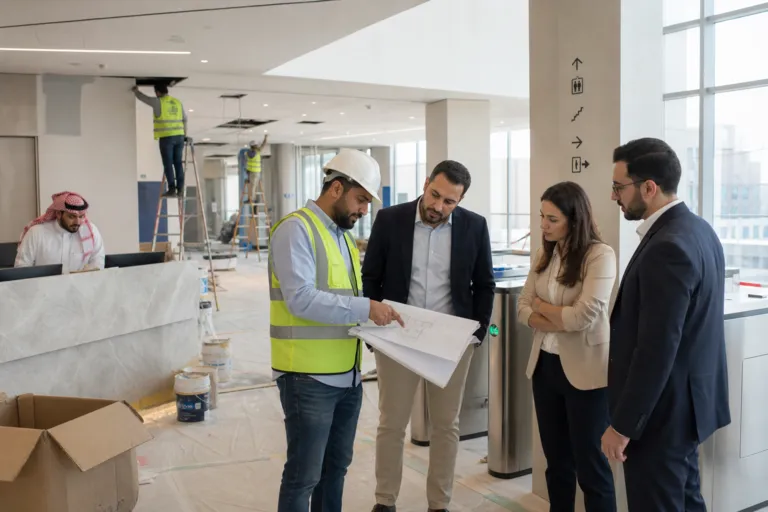
Occupancy signals are one reason Grade A supply and fit-outs are attracting attention. Economy Middle East reports that demand for office space in Riyadh has led to occupancy levels exceeding 97% for Grade A office buildings. Ken Research, in a separate update, describes office occupancy stabilizing at around 90% and points to sustained growth in Grade A developments, including KAFD, Al Olaya, and Diriyah Gate. Ken Research also states that Grade A supply is expected to expand at a CAGR of 6–8% through 2030, supported by sustainability-focused, LEED-certified projects appealing to global occupiers. For delivery teams, that mix implies more concurrent shell-and-core completions and more time-sensitive tenant improvements, including higher-spec finishes and building systems coordination.
Cost and capacity constraints will shape how Grade A office construction in Riyadh for RHQ-driven demand is phased and procured. Economy Middle East cites Turner & Townsend, stating Riyadh is among the most expensive cities globally to build in, with average construction costs around USD 3,112 per square meter. The same report notes equipment lead times extending to as long as 25 weeks, alongside supply chain competition and volatility. These conditions can push occupiers and landlords to prioritize early design decisions, lock in long-lead items, and plan fit-out packages well before leases commence. At the market level, Mordor Intelligence also flags high construction costs and the need for disciplined project phasing, even as rents for top-tier space in Riyadh and Jeddah continue to firm despite new supply.
What is driving the surge in Grade A offices and fit-outs in Riyadh?
How tight is Grade A office occupancy in Riyadh?
What does the Saudi Arabia office market forecast imply for Grade A growth to 2030?
What cost and delivery risks matter most for Grade A office construction in Riyadh tied to RHQ demand?
Talk to us for your needs in:
-
Sustainable Construction Solutions
-
Strategic Construction Planning
-
Customer-Centric Construction Services
-
Operational Excellence in Construction
-
Leadership and Change Management for Construction
-
Digital Transformation in Construction
-
Saudi Construction Market Research
-
In-Depth Market Study for Construction
-
Market Intelligence and Insights in Construction
-
Feasibility Study and Assessment in Construction
-
Saudi Construction Benchmarking