
Saudi Arabia’s government procurement environment can be understood in tiers. Central government ministries and agencies operate under the Government Tenders and Procurement Law (GTPL), which establishes standardised tendering procedures, evaluation criteria, and contract administration requirements. Government-owned corporations and sovereign wealth fund portfolio companies, including Saudi Aramco, SABIC, the Public Investment Fund’s giga-project companies, and utilities, operate under their own procurement regulations with varying degrees of similarity to the GTPL. A third tier covers semi-governmental entities, regulatory bodies, and public universities, where procedures blend GTPL principles with institutional discretion. This structure matters because standardisation is not uniform across the whole market.
On the public procurement side, digital infrastructure is part of the standardisation push. The GTPL framework, updated in 2019 and amended through implementing regulations, established the Etimad platform as the Kingdom’s centralised electronic procurement system. Government tenders above specified thresholds are published on Etimad, creating a transparent and accessible marketplace for qualified suppliers and contractors. At the same time, this transparency comes with operational expectations. Suppliers may need sophisticated electronic bidding capabilities to participate consistently. Contractor classification also shapes who can bid: the Saudi Contractors Authority assigns grades based on financial capacity, technical capability, and project experience, determining maximum contract value and sectors.
What the 2026 GTPL Changes Mean for Contract Forms and Risk
In August 2026, Saudi Arabia’s Council of Ministers approved a new GTPL intended to enhance planning and execution efficiency and promote transparency, fairness, and equal opportunity in government tenders. The new law replaces several prescriptive features of the prior regime with a more flexible, efficiency-oriented framework. Reported changes include raising the procurement delegation limit to SAR 50 million, reducing the Ministry of Finance review period to up to four working days (from up to 15 working days under the previous law), and increasing the permissible contract value increase threshold to 20%. The GTPL also raises the direct procurement threshold to SAR 1 million and consolidates the bid opening and bid evaluation committees into a single committee.
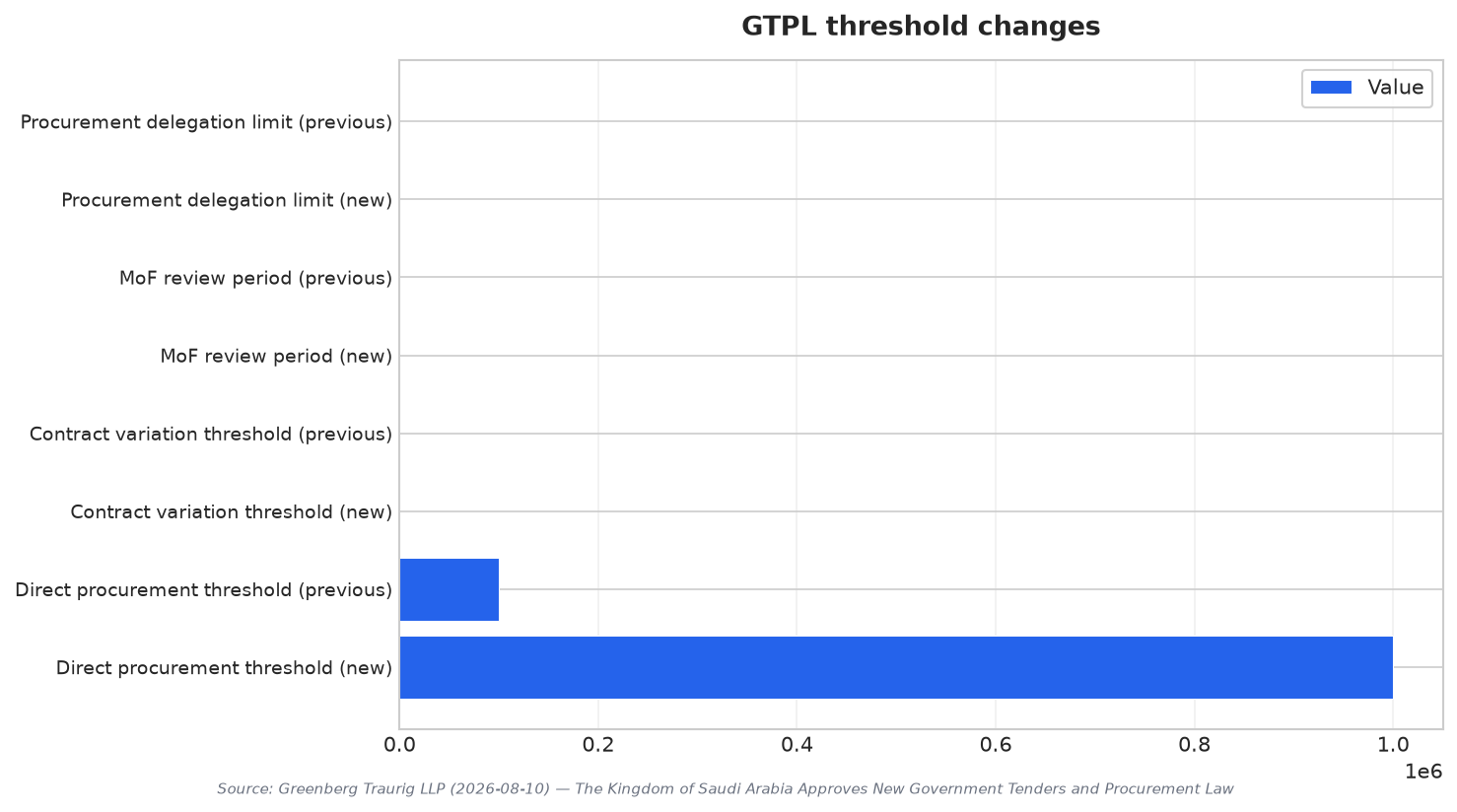
These procedural reforms connect directly to risk allocation during delivery. Greater delegation and faster Ministry of Finance review can shorten approval cycles that often affect mobilisation and early-stage performance. A higher variation threshold (20%) provides more room to adjust scope or pricing within defined limits, which can shift how parties price change risk and manage approvals. The GTPL also introduces a mechanism allowing government contracts to be novated or assigned from one government entity to another, and it allows the head of a government entity to delegate contract-signing authority without any financial limit. Separately, commentary on the new GTPL notes that it standardises requirements for submitting final performance guarantees across companies, promoting equality among bidders, and provides more certainty over payment provisions and corporate support requirements.
Contract forms still matter because Saudi projects often rely on established international templates that are then tailored. In practice, the most common construction contracts used in Saudi Arabia stem from FIDIC, and it is common for FIDIC contracts to be modified, often in favour of the employer. The redistribution of risk can be extensive, and the engineer’s role in the FIDIC Red Book form is often limited, with employer approval required for various important decisions. Alongside public-sector procurement standardisation, the Ministry of Justice, in collaboration with the Saudi Contractor’s Authority, launched the Unified Contract for Complete Construction (UCC) on 5 March 2024 to standardise construction contracts in the private sector, reduce contractual disputes, and enhance transparency. Together, these trends frame how a “public works standard contract” conversation in Saudi Arabia develops under the GTPL.
How does the GTPL affect public-works contracting in Saudi Arabia?
What are the key thresholds introduced or increased under the 2026 GTPL?
How does Etimad support standardised government procurement?
How do standard contract forms and risk allocation typically work on Saudi construction projects?
What does the private-sector UCC aim to achieve, and how is it different from the GTPL?
Talk to us for your needs in:
-
Sustainable Construction Solutions
-
Strategic Construction Planning
-
Customer-Centric Construction Services
-
Operational Excellence in Construction
-
Leadership and Change Management for Construction
-
Digital Transformation in Construction
-
Saudi Construction Market Research
-
In-Depth Market Study for Construction
-
Market Intelligence and Insights in Construction
-
Feasibility Study and Assessment in Construction
-
Saudi Construction Benchmarking