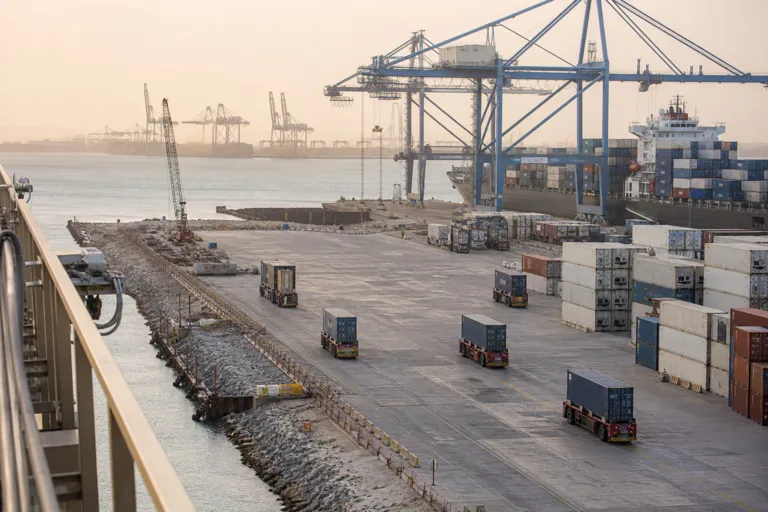
Red Sea Gateway Terminal (RSGT) and France’s CMA CGM have signed definitive agreements to jointly develop and operate Terminal 4 at the Islamic port of Jeddah, in collaboration with the Saudi Ports Authority (Mawani). Multiple reports describe the deal at roughly SAR1.6 billion, also reported as about $434 million, and position it as a major investment for Saudi Arabia’s maritime sector. The signing took place in Paris on the sidelines of the Saudi-French Investment Roundtable, in the presence of Crown Prince and Prime Minister Mohammed bin Salman and French President Emmanuel Macron. The project is framed by the parties as aligned with Saudi Arabia’s National Transportation and Logistics Strategy and the objectives of Vision 2030.
At the core of the plan is new annual capacity. Terminal 4 is described as adding up to 2.6 million TEUs per year within the framework of RSGT’s current concession in Jeddah. That capacity target is repeatedly linked to goals that include attracting more global shipping lines and services, increasing cargo flows, and expanding connectivity with international markets. The sources emphasize Jeddah’s Red Sea position on routes connecting Asia, Europe, and Africa, and they also highlight the Red Sea corridor’s sensitivity in global container trade due to its direct connection to the Suez Canal. In this context, the agreement is presented as both a physical expansion and a reliability play for import and export movements.
What the Expansion Adds: Marine Works, Cranes, and Systems
The construction scope described for Terminal 4 goes beyond a simple yard expansion. The project includes deep-water docks sized to accommodate the world’s largest container ships, plus draft-deepening intended to support efficient calls by next-generation vessels. It also includes the commissioning of ten new ship-to-shore (STS) dock cranes and the deployment of advanced terminal management systems. While no construction or start-up timetable was disclosed in the latest announcement, the elements cited in the sources connect marine construction and terminal equipment procurement to a single operational outcome: handling larger vessels while drawing additional international services to Jeddah Islamic Port.
The Terminal 4 agreement also fits a broader shift discussed in container shipping commentary. Mordor Intelligence notes that terminal ownership continues to rise as a defensive hedge against landside congestion and as a lever to capture new revenue pools, while carriers concentrate on network reliability and new alliance formations targeting on-time performance above 90%. The same report projects the global container shipping market size rising from USD 119.65 billion in 2025 to USD 123.14 billion in 2026 and reaching USD 142.07 billion by 2031, at a 2.92% CAGR over 2026–2031. Against that backdrop, the Jeddah project is portrayed as a strategic asset decision as well as an infrastructure upgrade.
For observers tracking Red Sea container terminal construction in Saudi Arabia, Terminal 4 is being positioned as a long-term alliance that pairs RSGT’s local operating experience with CMA CGM’s global network and terminal operating know-how. One report states CMA CGM has stakes in 64 port terminals around the world, underscoring the group’s emphasis on terminals as an operational lever. Mawani’s leadership is quoted describing the agreement as a reference point for investment attractiveness and as part of ongoing work to develop port infrastructure and improve competitiveness. Taken together, the announced capacity of up to 2.6 million TEUs per year, the SAR1.6 billion investment, and the deep-water and crane package define the upgrade in practical, buildable terms.
What is the announced investment for Jeddah Islamic Port Terminal 4?
How much annual capacity is Terminal 4 expected to add?
What marine construction and equipment are included in the Terminal 4 plan?
How does this relate to Red Sea container terminal construction in Saudi Arabia?
What does the Mordor Intelligence report say about the broader container shipping market context?
Talk to us for your needs in:
-
Sustainable Construction Solutions
-
Strategic Construction Planning
-
Customer-Centric Construction Services
-
Operational Excellence in Construction
-
Leadership and Change Management for Construction
-
Digital Transformation in Construction
-
Saudi Construction Market Research
-
In-Depth Market Study for Construction
-
Market Intelligence and Insights in Construction
-
Feasibility Study and Assessment in Construction
-
Saudi Construction Benchmarking