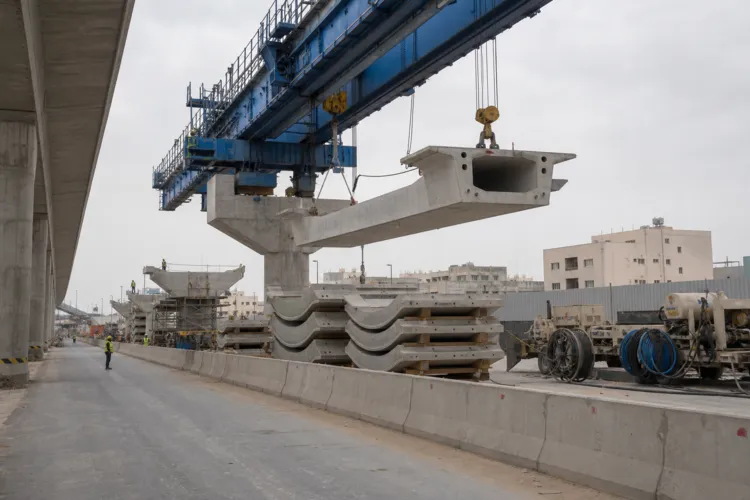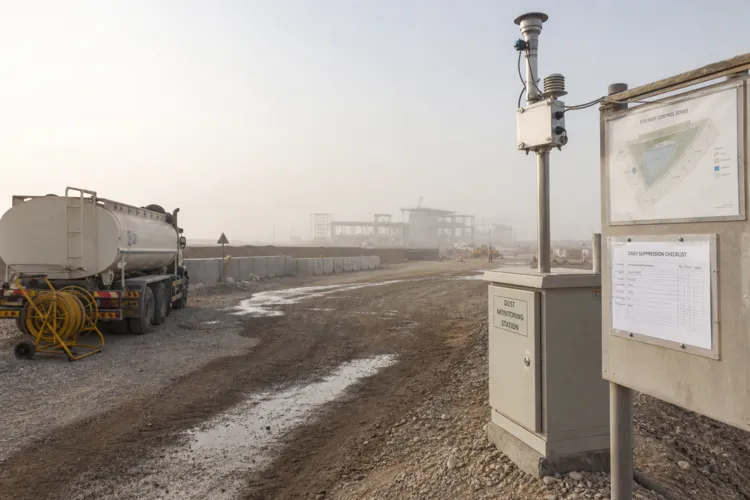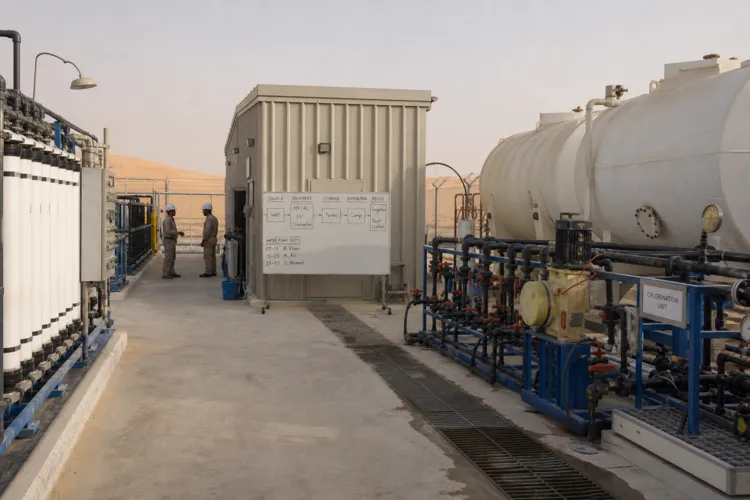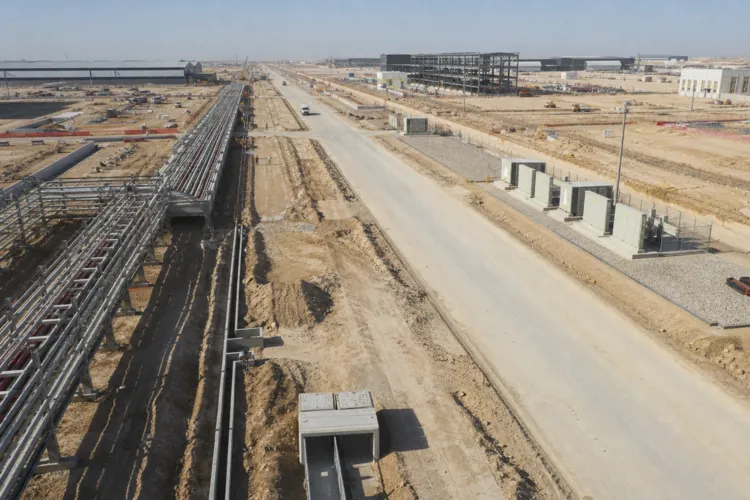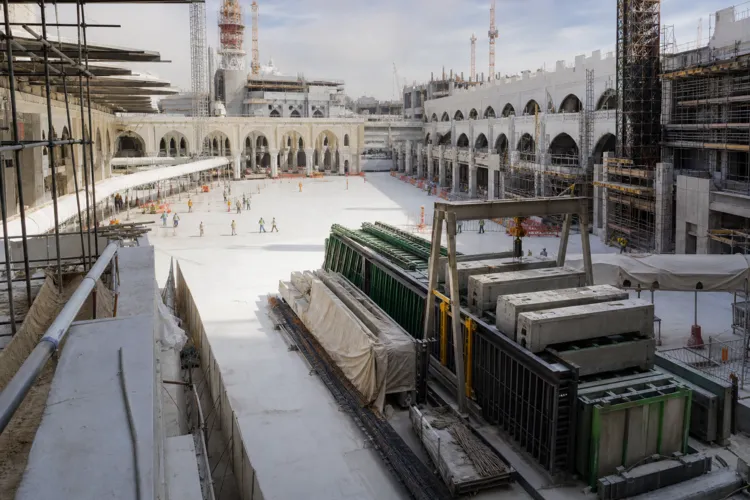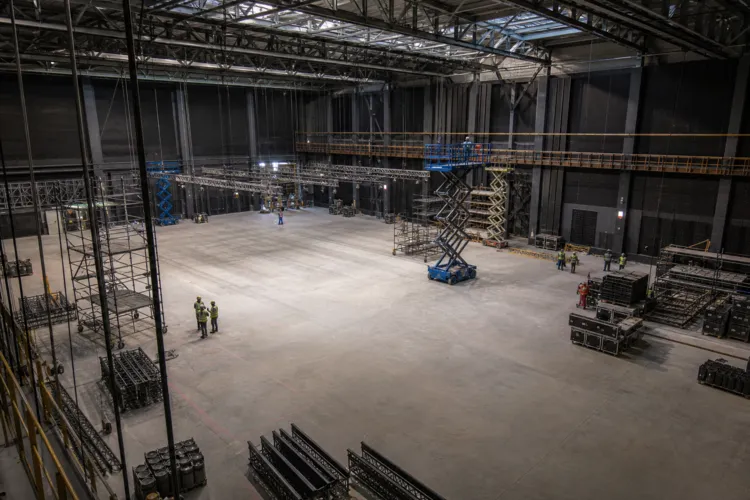
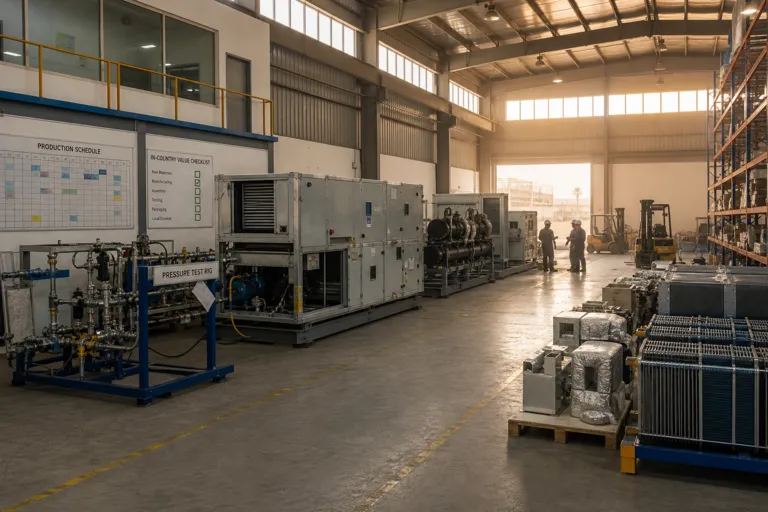
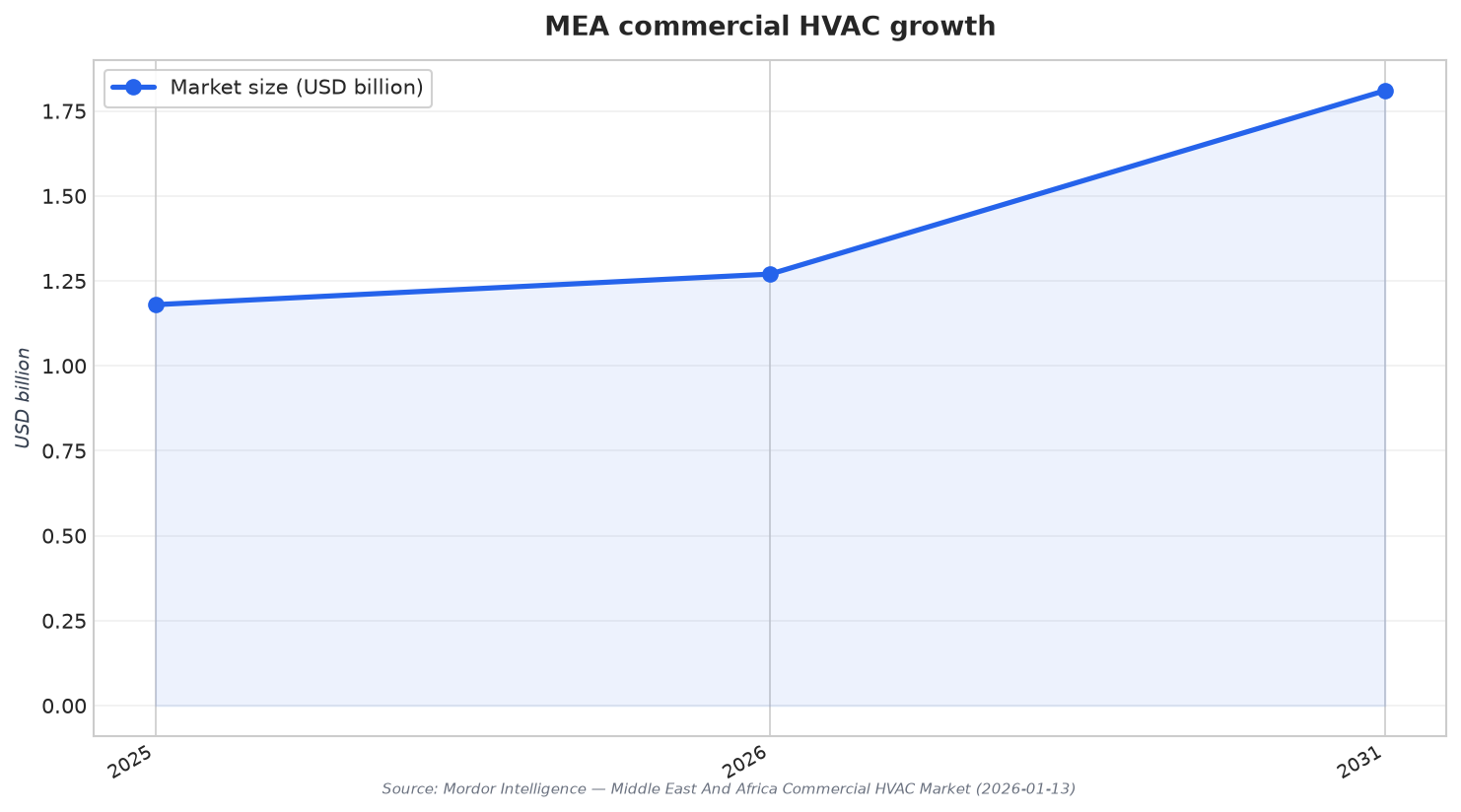
Saudi Arabia’s giga-project wave is raising the bar for cooling design, procurement, and delivery. In the global MEP services market, Mordor Intelligence values 2025 at USD 172.46 billion and projects USD 239.41 billion by 2030, at a 6.78% CAGR, citing large-scale Gulf giga-projects as a source of design-build backlogs. In the Middle East and Africa, Mordor Intelligence values the commercial HVAC market at USD 1.18 billion in 2025 and forecasts it to reach USD 1.81 billion by 2031, at a 7.42% CAGR. Within that region, Saudi Arabia held 27.60% revenue share in 2025 and is also the fastest-growing geography, at 8.12% CAGR through 2031.
Giga-project cooling demand is not only about more units; it is about specification complexity and 24/7 operating expectations. Mordor Intelligence notes that commercial megaproject construction in the GCC is reshaping requirements, with systems expected to manage wide indoor-outdoor thermal gradients, stringent humidity targets, and continuous operation. Data centers and IT hubs are also the fastest-growing end use in the same Middle East and Africa commercial HVAC report, with a projected 7.96% CAGR to 2031, reinforcing the need for precision cooling and controls. Controls are also the fastest-expanding component category, projected at an 8.74% CAGR to 2031, which increases the importance of commissioning capability and local service coverage alongside equipment supply.
What Localization Looks Like Across Equipment, Components, and Standards
Localization is moving from aspiration to visible capacity additions and compliance-led replacement cycles. Vocal Media reports that Johnson Controls Arabia launched the Kingdom’s first AHRI-certified chiller production line at King Abdullah Economic City in May 2025, positioned “right in step” with the construction wave tied to projects such as NEOM, Qiddiya, and the Red Sea Project. On the demand side, retrofit work is already dominant across the region: Mordor Intelligence reports retrofits accounted for 57.10% of the Middle East and Africa commercial HVAC market in 2025 and are forecast to grow at an 8.52% CAGR to 2031, driven in part by replacing R-22 equipment to meet mandates including SASO 2663:2021.
Component localization also matters because giga-project schedules can be disrupted by long lead items and imported subassemblies. MarketsandMarkets values the Saudi Arabia HVAC linesets market at USD 341.3 million in 2025 and projects USD 522.0 million by 2030, a CAGR of 8.9%. For hydronic and district-cooling-adjacent applications, IndexBox notes that international trade is the “lifeblood” of the Middle East plate heat exchanger (PHE) market for HVAC, with a significant portion of finished equipment, core components, and raw materials imported, and identifies Jebel Ali (UAE), Dammam (Saudi Arabia), and Hamad (Qatar) as primary gateways. In practice, MEP HVAC equipment localization for Saudi construction can combine domestic assembly and certified production where feasible, while strengthening inventory strategy, logistics planning, and EPC partnerships for still-imported categories.
Technology choices and connected operations further shape localized supply strategies. Mordor Intelligence reports VRF held 34.30% share of the Middle East and Africa commercial HVAC market in 2025 and that VRF is forecast to grow at an 8.21% CAGR through 2031; the same report states VRF can cut electricity use by 48–52% in hot-dry conditions versus packaged and rooftop units. Vocal Media adds that in Riyadh, HVAC systems are being integrated into centralized building control platforms, and that Samsung and Gree both report 35% growth in connected AC sales. For Saudi giga-project delivery teams, the localization opportunity is not just manufacturing. It is also building local capability for controls integration, commissioning, retrofit execution, and aftersales responsiveness aligned with tightening standards and complex operating profiles.
Why is Saudi Arabia prioritizing localization for MEP and HVAC equipment in construction?
What data shows Saudi Arabia’s HVAC demand is rising within the region?
How does the HVAC linesets market indicate local supply chain opportunity in Saudi Arabia?
What has changed recently in local manufacturing for chillers in Saudi Arabia?
How can MEP HVAC equipment localization support Saudi construction projects without fully replacing imports?
Talk to us for your needs in:
-
Sustainable Construction Solutions
-
Strategic Construction Planning
-
Customer-Centric Construction Services
-
Operational Excellence in Construction
-
Leadership and Change Management for Construction
-
Digital Transformation in Construction
-
Saudi Construction Market Research
-
In-Depth Market Study for Construction
-
Market Intelligence and Insights in Construction
-
Feasibility Study and Assessment in Construction
-
Saudi Construction Benchmarking