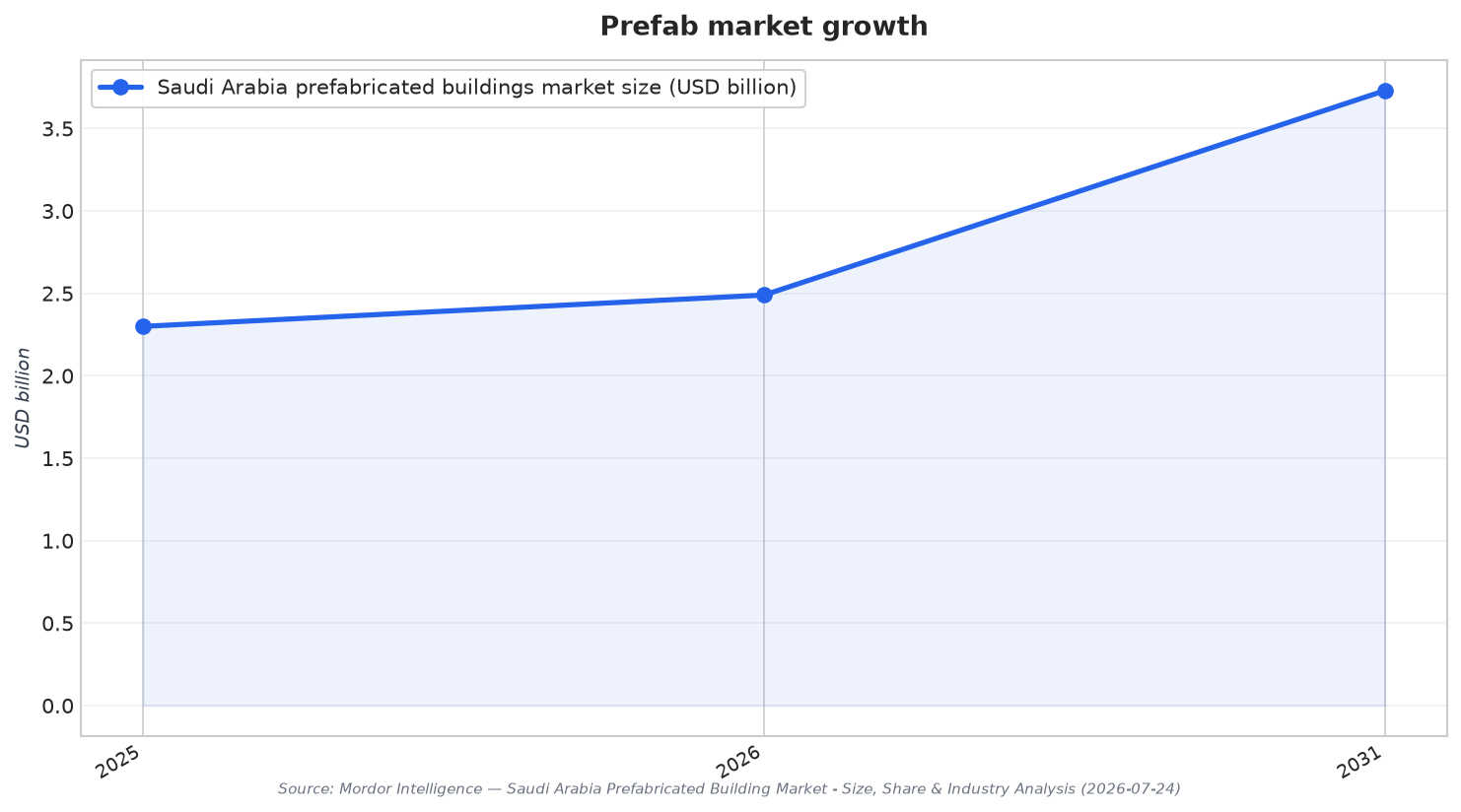
Offsite structural steel fabrication in Saudi Arabia is becoming a practical response to compressed delivery schedules across Vision 2030 programs. Market-wide indicators point in the same direction. A 2025 industry release says the Saudi Arabia prefabricated building and structural steel market reached almost USD 1.97 billion in 2024. Separately, Mordor Intelligence estimates the Saudi Arabia prefabricated buildings market at USD 2.49 billion in 2026, up from USD 2.30 billion in 2025, with a 2031 projection of USD 3.73 billion at an 8.37% CAGR over 2026–2031. These trajectories reinforce why developers are leaning on factory workflows that can be repeated, audited, and scaled.
The operational logic is straightforward. MarkWide Research describes prefabricated building and structural steel as factory-manufactured structural assemblies using hot-rolled or cold-formed sections, welded or bolted connections, and corrosion-resistant coatings engineered for rapid site erection. It also notes that Saudi Arabia is fragmenting prefabricated capacity across Jubail, Rabigh, and Dammam industrial clusters to shorten lead times for NEOM and Red Sea developments. In structural fabrication, Mordor Intelligence highlights how remote giga-projects drive new clusters, citing that the Rest-of-Saudi-Arabia region is projected to grow at a 7.12% CAGR to 2030, with Tabuk near NEOM called out as an area where incentives such as rent-free land and duty relief attract greenfield workshops.
What “Scaling Local Capacity” Really Means for Giga-Project Frames
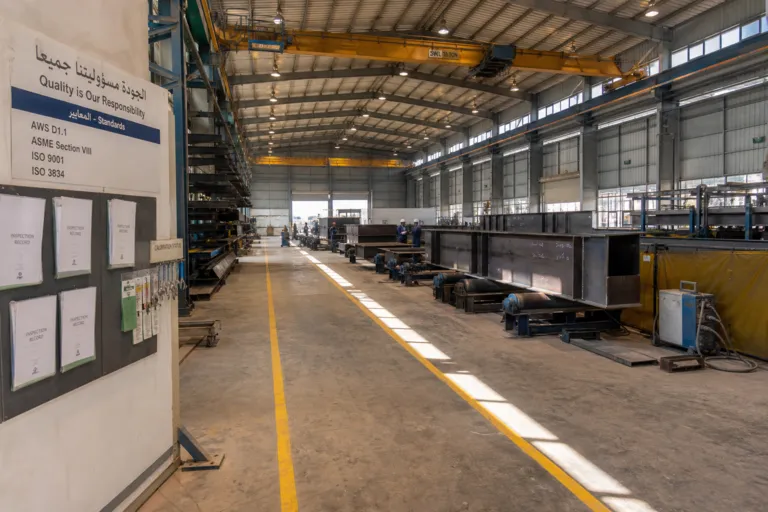
Scaling is not only about volume. It is about producing the right steel forms and assembling them to minimize site work in hard-to-access locations. Mordor Intelligence reports heavy sections dominated with 41.53% of the Saudi Arabia structural steel fabrication market share in 2024, reflecting demand for high-load columns, bridge girders, and stadium roof trusses. The same source frames giga-project requirements around marine-grade plate structures, corrosion-resistant tubular foundations, and ultra-long beams shipped in modular pods to remote desert or coastal sites. This is where off-site assembly of wall panels, roof cassettes, and fully fitted service modules becomes a framing strategy, not just a procurement choice.
Scale also depends on who can integrate fabrication, engineering, and delivery. MarkWide Research points to differentiated positions among Saudi players: Zamil Steel is described as leveraging integrated coil-to-building production for commercial and industrial contracts; Al Jazera Factory For Engineering Construction Co. Ltd. is described as anchoring its position through specialized heavy-gauge structural fabrication for petrochemical clients; and Saudi Building Systems Mfg Co. is described as differentiating via turnkey design-build capabilities that reduce on-site labor dependency. These models align with a “flight-to-scale” dynamic highlighted by Mordor Intelligence in prefabricated buildings, where SBC 2018 enforcement is described as narrowing the field to operators with advanced quality-management systems.
Compliance and procurement rules shape how quickly capacity can be qualified for giga-project packages. MarkWide Research states that SFDA material certification protocols, Saudi Building Code seismic provisions, and SASO quality conformity assessments shape product specifications and market access thresholds for domestic and imported structural components. It adds that the Saudi Standards, Metrology and Quality Organization enforces mandatory compliance for steel grades, welding procedures, and fire-resistance ratings that directly influence procurement decisions. On the demand side, Mordor Intelligence notes Riyadh led with a 34.60% share of the prefabricated buildings market in 2025, while Jeddah is the fastest-growing city segment at a 9.66% CAGR to 2031. For structural steel fabrication revenue, Riyadh dominated with a 34.56% share in 2024, underscoring where qualification, labor, and supply chain depth are already concentrated.
Why is Saudi Arabia pushing more structural work into off-site fabrication for giga projects?
What market figures show momentum behind prefabrication in Saudi Arabia?
Which structural products are most tied to large-frame demand in Saudi Arabia?
How do standards and certification affect offsite structural steel fabrication in Saudi Arabia?
How is offsite structural steel fabrication in Saudi Arabia being positioned to scale local capacity?
Talk to us for your needs in:
-
Sustainable Construction Solutions
-
Strategic Construction Planning
-
Customer-Centric Construction Services
-
Operational Excellence in Construction
-
Leadership and Change Management for Construction
-
Digital Transformation in Construction
-
Saudi Construction Market Research
-
In-Depth Market Study for Construction
-
Market Intelligence and Insights in Construction
-
Feasibility Study and Assessment in Construction
-
Saudi Construction Benchmarking