Saudi Arabia’s electricity system is being pulled in two directions at once. Vision 2030 pushes procurement of cleaner generation, while demand drivers keep rising. Cooling loads create 70% of summer peaks, and tariff reforms have made industrial and commercial customers active investors in on-site generation and efficiency. At the same time, licensing has been streamlined. Plants below 500 MW can now clear licensing in six months, a quarter of the previous timeline, which supports faster independent power producer (IPP) participation. Grid bottlenecks still matter, but a USD 20 billion modernization plan anchored in HVDC links and smart meters is underway to help integrate new assets.
Digital infrastructure is a core part of the load story. Mandatory cloud-first directives require all ministries and public agencies to offload legacy workloads into sovereign infrastructure by 2027. Hyperscalers are also committing long-horizon capital, including AWS’s USD 5.3 billion commitment to launch its first local cloud region by 2026, while Microsoft established a regional headquarters in Riyadh with additional capacity pipelines to follow. In data-center buildouts, Mordor Intelligence projects the Saudi Arabia data center construction market at USD 2.11 billion in 2026, growing at a 30.91% CAGR to reach USD 8.11 billion by 2031. Colocation held 56.40% of 2025 spend, but self-build projects are rising 31.75% per year, tightening requirements for reliable, dispatchable generation and strong grid access.
Why IPPs and Gas Projects Matter Alongside Renewables
Renewables are scaling quickly, but they are being built into a system that still needs firm capacity. The National Renewable Energy Program has awarded 21 projects totaling 19 GW, and seven plants equaling 4.1 GW were operating by late 2024. Grid-connected renewables reached 6.5 GW in 2024 and are scheduled to double to 12.7 GW in 2025. Yet combined-cycle builds continue to anchor reserve margin stability, and IPPs are central to execution. In the Saudi Arabia Power EPC market, regulated utilities held 56.8% of 2025 spending, but IPPs are forecast to expand 5.7% annually to 2031. ACWA Power’s SAR 31 billion worth of PPAs in 2025 illustrates the scale of contracting activity that supports new build decisions.
Recent project awards show how combined-cycle and industrial cogeneration pipelines are forming in parallel with data-center growth. April 2026: the Rabigh 2 IPP Expansion Project secured a PPA for 2,313.5 MW. June 2026: Doosan Enerbility signed a USD 556 million EPC contract for the Jafurah Combined Heat and Power Plant Phase 2, reinforcing industrial-linked cogeneration tied to upstream gas development and the need for integrated power-and-steam engineering. While competitive tenders emphasize renewables, Mordor also notes combined-cycle gas turbine builds such as the 3.6 GW Rumah 2 project as a stabilizing element. Siemens Energy booked USD 1.6 billion of orders for Rumah 2 and Nairiyah 2 in March 2025, underscoring the depth of the thermal EPC backlog.
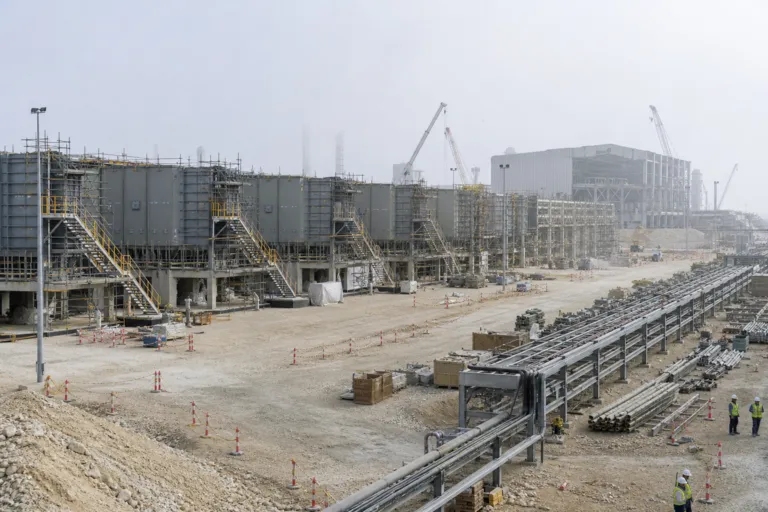
This is where combined cycle gas power plant construction in Saudi Arabia becomes a practical bridge between fast-growing digital loads and industrial expansion. Data-center power infrastructure is also scaling, with the Saudi Arabia data center power market valued at USD 286.6 million in 2026 and projected to reach USD 607.28 million by 2031 at a 16.21% CAGR. Tier IV demand is expected to top USD 315.8 million by 2031, and design choices like twin power corridors and ring bus architectures reinforce the need for stable upstream supply. As more projects queue up, EPC discipline and compliance remain central, shaped by SEC grid codes, SFDA industrial safety mandates, and GOSI contractor qualification requirements.
What is driving Saudi Arabia’s new electricity demand from data centers?
How do IPPs influence power project delivery in Saudi Arabia?
Which recent gas-linked EPC awards highlight industrial demand growth?
How does combined-cycle gas power plant construction in Saudi Arabia fit with renewables growth?
What power and resiliency trends are shaping data-center energy infrastructure?
Talk to us for your needs in:
-
Sustainable Construction Solutions
-
Strategic Construction Planning
-
Customer-Centric Construction Services
-
Operational Excellence in Construction
-
Leadership and Change Management for Construction
-
Digital Transformation in Construction
-
Saudi Construction Market Research
-
In-Depth Market Study for Construction
-
Market Intelligence and Insights in Construction
-
Feasibility Study and Assessment in Construction
-
Saudi Construction Benchmarking