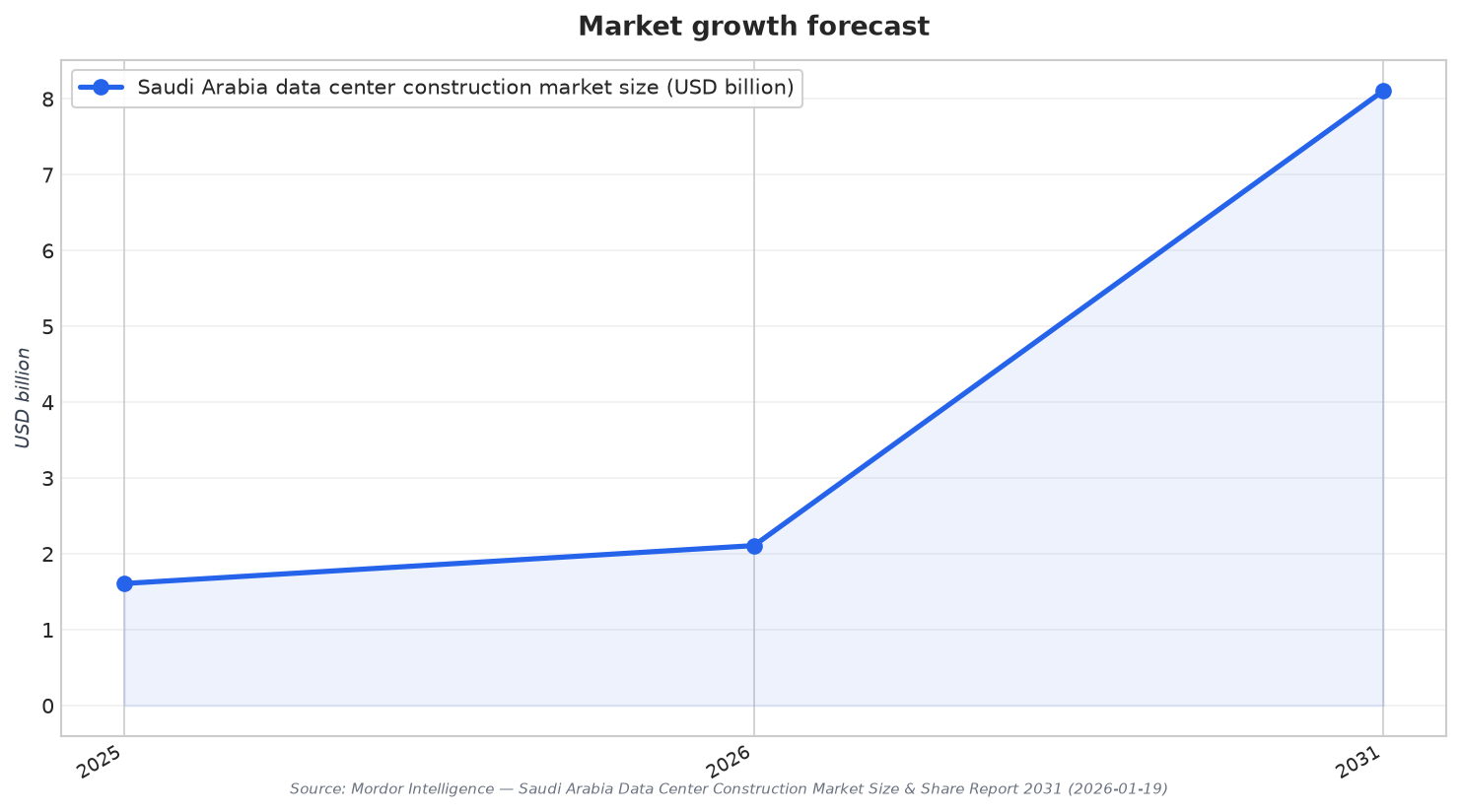
Saudi Arabia’s data-center construction pipeline is being shaped by a clear mix of policy and demand. Mordor Intelligence values the Saudi Arabia data center construction market at USD 1.61 billion in 2025 and estimates growth from USD 2.11 billion in 2026 to USD 8.11 billion by 2031, at a CAGR of 30.91% (2026–2031). The same report links momentum to Vision 2030 incentives, mandatory data-sovereignty rules, and rapid submarine-cable additions. Vision 2030 allocates USD 100 billion to technology, and the report cites accelerated permit pathways that cut data-center approvals to six months. It also cites commitments exceeding USD 15 billion from AWS and Microsoft, underscoring why speed-to-power and build certainty matter in the Kingdom.
On the demand side, multiple sources describe hyperscale and colocation scaling in parallel. Mordor reports colocation held 56.40% revenue share in 2025, while self-build hyperscalers show the highest growth at a 31.75% CAGR. A separate SaudiConstructionConsulting guide (citing IMARC via Futurism) values the Saudi Arabia data center market at USD 2.43 billion in 2025, projecting USD 8.49 billion by 2034 at a 14.93% CAGR (2026–2034), and values the Saudi data center colocation market at USD 674.8 million in 2025. Project announcements reinforce the scale of what is being planned: in July 2025, Al Moammar Information Systems Company (MIS) announced an additional 112 MW of capacity with Saudi Data Centre Fund 1, and in November 2024 Pure Data Centers and Dune Vaults announced hyperscale campuses with IT capacity exceeding 100 MW.
Why Modular and Prefabricated Delivery Fits Saudi Schedules
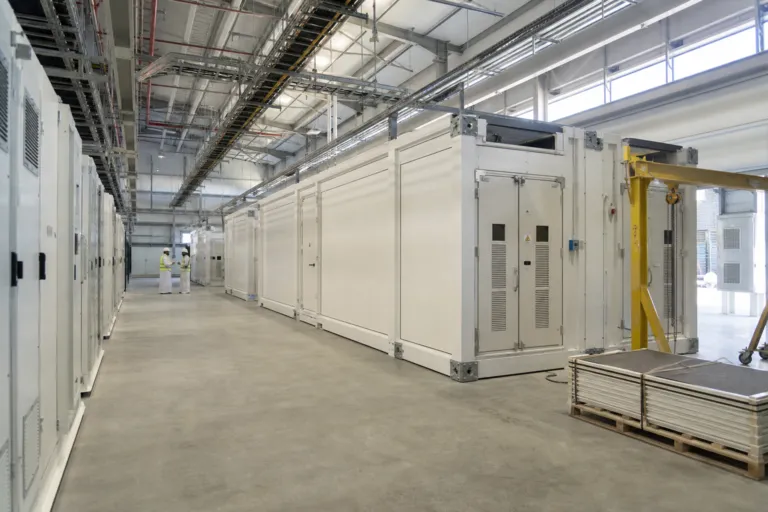
This is where modular prefabricated data center construction in Saudi Arabia becomes less of a niche method and more of a delivery strategy. MarketsandMarkets projects the Saudi Arabia modular data center market will grow from USD 451.7 million in 2025 to USD 1,015.0 million by 2030 at a 17.6% CAGR. It highlights demand for faster deployment and cost-efficient solutions, and points to all-in-one modular systems that integrate IT, power, cooling, security, and monitoring into a prefabricated unit. The same source says enclosures are expected to hold the largest share through the forecast period, emphasizing their role in protecting equipment from extreme heat and dust. In parallel, Mordor’s market commentary notes that tier economics are shifting as vendors release modular Tier-4 building blocks, narrowing the gap with Tier 3 as licensing regimes embed Tier-4 attributes such as dual power feeds and advanced fire suppression.
Speed-to-power also depends on aligning the build with the Kingdom’s infrastructure constraints, not only on-site construction pace. SaudiConstructionConsulting (citing Greenberg Traurig) frames the contractor’s question as integration into existing power, fuel, and water systems without creating future network stress, and notes policy communications emphasizing siting new large loads where grid capacity supports long-term development. Mordor’s construction segmentation shows why electrical scope is central: power-backup systems held 52.90% share of market size in 2025, while power-distribution solutions are forecast to advance at a 31.12% CAGR (2026–2031). Mechanical scope is equally material, with cooling systems accounting for 41.30% of spending in 2025 in Saudi Arabia, reinforcing why standardized, repeatable prefabricated mechanical-and-electrical blocks can de-risk schedules.
Capacity planning signals the same direction. Mordor reports Saudi Arabia’s IT load requirements rising from 0.41 thousand MW in 2025 to 1.03 thousand MW in 2030. A Moduledge summary citing PwC (2025) states Saudi Arabia has 222 MW operational (Q1 2025) and is planning 760 MW by 2030 at a 29% CAGR. Moduledge also cites a DataVolt/NEOM project: a USD 5B, 1.5 GW net-zero AI factory in Oxagon. These figures are not interchangeable, but together they show why owners and EPC teams are looking for repeatability, phased commissioning, and factory-style quality control. Modular and prefabricated approaches can align procurement, electrical distribution, and cooling packages to a predictable build rhythm, while still supporting the tier and compliance direction described across the Saudi sources.
How fast is Saudi Arabia’s data-center construction market expected to grow?
What share did Tier 3 hold, and what is happening to Tier 4?
What is the growth outlook for Saudi Arabia’s modular data center market?
Which project announcements signal hyperscale campus sizing in Saudi Arabia?
How does modular, prefabricated data-center construction support Saudi Arabia’s build-out goals?
Talk to us for your needs in:
-
Sustainable Construction Solutions
-
Strategic Construction Planning
-
Customer-Centric Construction Services
-
Operational Excellence in Construction
-
Leadership and Change Management for Construction
-
Digital Transformation in Construction
-
Saudi Construction Market Research
-
In-Depth Market Study for Construction
-
Market Intelligence and Insights in Construction
-
Feasibility Study and Assessment in Construction
-
Saudi Construction Benchmarking