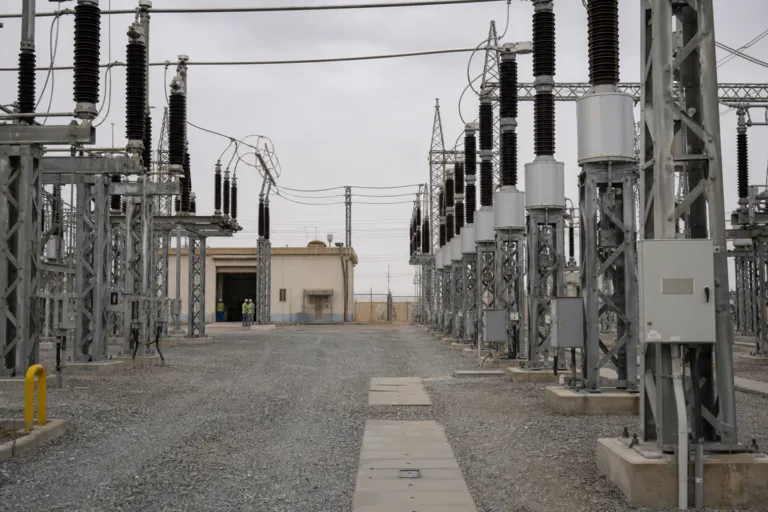
Saudi Arabia’s push to connect new generation, battery energy storage systems (BESS), and giga-project loads is elevating the role of long-distance, high-voltage corridors, including 380 kV builds. OMR Business Consulting estimates the Saudi Arabia transmission line market at USD 3.67 billion in 2024 and projects it to reach approximately USD 4.13 billion by 2035. The same source links this direction to Vision 2030 priorities such as diversifying energy sources and improving energy efficiency, alongside rapid urbanization and industrialization that are increasing electricity demand. In this environment, grid expansion is not only a utility requirement. It becomes an enabling layer for new cities, industries, and large infrastructure developments that need dependable power delivery.
Within the Kingdom, the high-voltage segment holds the major share of the transmission line market because it can transport large amounts of electricity over long distances with minimal losses, according to OMR Business Consulting. That same analysis also states overhead transmission lines hold the major share, described as relatively more affordable to install and maintain than underground and submarine alternatives, and requiring less labor and materials. For planners focused on connecting remote generation to load centers, these preferences shape route selection, bill of materials, and construction sequencing. This is where high voltage transmission line construction Saudi Arabia planning often turns into a practical tradeoff between speed, cost, and the realities of right-of-way and corridor scale.
From Generator-to-Load: Why Interconnection Strategy Is Changing
Globally, the transmission line construction market is being pulled by grid modernization and renewable integration. DataIntelo values the global transmission line construction market at USD 78.4 billion in 2025 and projects USD 148.6 billion by 2034, expanding at a 7.4% CAGR from 2026 to 2034. It also reports that cumulative global investment in electricity grid infrastructure surpassed USD 310 billion in 2025, with transmission line construction accounting for roughly one-quarter of that total. For Saudi developers and EPC teams, these global figures do not describe local outcomes, but they do reflect a broader reality: new generation is often far from demand, and the construction stack must deliver lines, towers, conductors, and supporting hardware fast enough to keep pace with new projects.
Large-load interconnection pressure is also reframing how new loads get served, especially where queue congestion and limited transmission space create curtailment risk. Ascend Analytics modeling shows that a 4-hour behind-the-meter (BTM) BESS paired with a non-capacity-backed load connection can provide sufficient coverage for nearly all curtailment scenarios in most power markets. The same source notes two recurring ideas across markets: if load is willing to take curtailment risk on transmission or capacity availability, power can be provided as-available; and if generation is electrically local to new large loads and limited to not exceed the load, it is safe to interconnect it. For giga-project loads, this points to hybrid strategies that combine grid connection with local flexibility, even as 380 kV transmission development remains central for bulk delivery.
Construction delivery, however, still depends on components and procurement practices that can shift timelines. IndustryResearch.biz frames typical project bills of materials across equipment categories such as transformers, switchgears, transmission towers, power cables and wires, and others like insulators, relays, and ICT, with each segment representing about 10–35% of material and equipment counts depending on scope. MarkWide Research adds technical context: transmission lines span voltage ratings from 66 kV to 800 kV and beyond, and are engineered conductor systems designed to transport power from hundreds of meters to thousands of kilometers. It also highlights that right-of-way acquisition can extend commissioning by 18–36 months in cited geographies, underscoring why routing discipline, stakeholder management, and realistic schedules matter when building new 380 kV connections for generation, BESS, and large loads.
What is the projected size of Saudi Arabia’s transmission line market?
Which transmission line type holds the major share in Saudi Arabia, and why?
How does BESS relate to serving new giga-project loads when transmission is constrained?
How big is the global transmission line construction market according to the sources?
What should stakeholders expect when planning high voltage transmission line construction in Saudi Arabia?
Talk to us for your needs in:
-
Sustainable Construction Solutions
-
Strategic Construction Planning
-
Customer-Centric Construction Services
-
Operational Excellence in Construction
-
Leadership and Change Management for Construction
-
Digital Transformation in Construction
-
Saudi Construction Market Research
-
In-Depth Market Study for Construction
-
Market Intelligence and Insights in Construction
-
Feasibility Study and Assessment in Construction
-
Saudi Construction Benchmarking